Keys to Editorial Design for Newspapers
Have you ever stopped to think about the complex process behind the layout of news, headlines and images in a newspaper? Beyond copywriting, there is a fundamental discipline: the editorial design of newspapers. This art is not only about making the pages look good, but also about guiding the reader through a clear and engaging flow of information, ensuring that the most important messages are highlighted and absorbed efficiently.
In a world saturated with digital information, the design of print publications such as newspapers remains a mainstay of news communication. Layout, visual hierarchy and typographic selection are crucial to maintaining credibility and impact. Good newspaper editorial design strikes the perfect balance between aesthetics and functionality, transforming a simple sheet of paper into a powerful and enjoyable informational tool. Join us as we unravel the secrets of this fascinating field of graphic design.
Beyond Aesthetics: What Does Newspaper Design Involve?
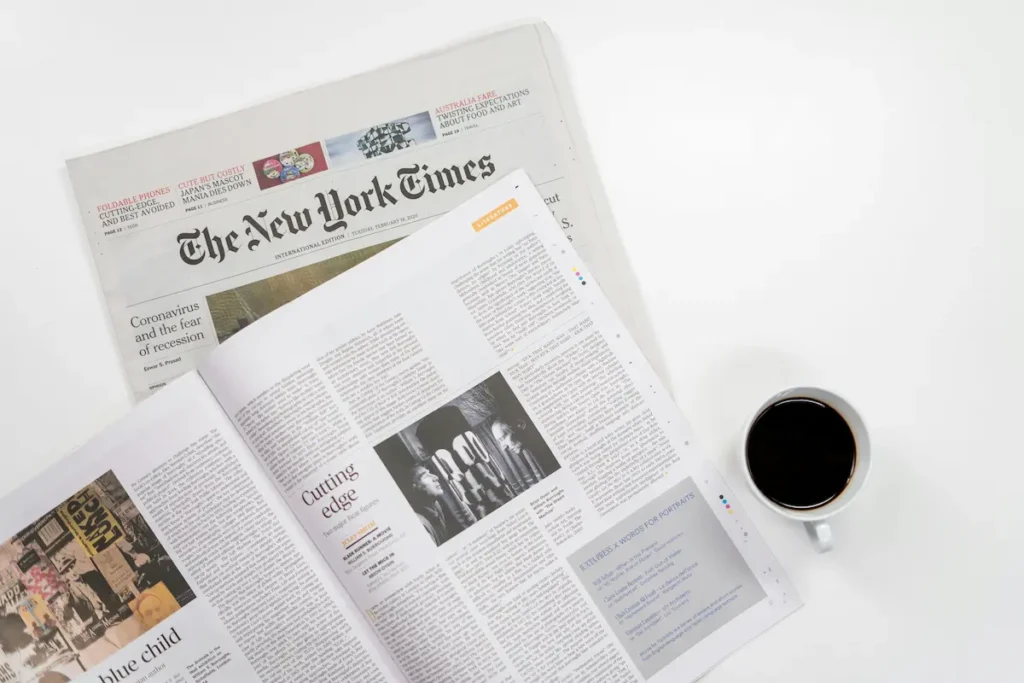
Newspaper design goes far beyond simply placing text and images on a page. It is a meticulous process from the conceptualisation of the layout to the choice of typography and the use of colour. The main goal is to create a smooth and seamless reading experience.
KEY ELEMENTS IN EDITORIAL DESIGN FOR NEWSPAPERS
Visual Hierarchy
This refers to the organisation of elements on the page to guide the reader's eye. Headlines, subheads, body text and images are designed with different sizes and visual weights to indicate their importance.
Layout and Grid
A grid system is the underlying structure that ensures consistency and order on all pages. This invisible guide allows the designer to align text and graphics in a coherent way.
3.Typography
The choice of typeface is crucial. Serif fonts are often used for body text, as they improve readability in narrow columns. Sans-serif fonts can be used for headlines or highlights to create contrast.
4. Use of White Space
Negative space is not a vacuum, but a powerful design tool. It allows elements to "breathe", reduces visual clutter and improves comprehension of content.
The Importance of Layout and Reading Flow
Layout is the skeleton of a newspaper. Without a solid structure, information would become chaotic and difficult to digest. A good newspaper editorial design uses a modular grid that divides the page into columns, making it easier to read and adapt the content. Think about how the main news is distributed on the front page: an eye-catching headline, a high-impact image and a concise summary invite the reader to follow.
Reading flow is another fundamental aspect. The human eye tends to read from top to bottom and left to right (in Western cultures), and design should take advantage of this natural pattern. An intuitive layout allows the reader to navigate easily between articles, graphics and photos, finding the information they are looking for effortlessly. This applies not only to the front page, but to all sections: sports, finance, culture, etc., each with its own visual identity, but maintaining the coherence of the publication.
A Practical Example: The Art of the Title Page
A newspaper's front page is its calling card. A graphic designer must synthesise the most important news of the day in a single glance. This involves:
- Select the main headline that captures the essence of the day.
- Choose the most striking photograph that complements the story.
- Create a clear hierarchy where the most relevant things are immediately visible.
This synergy between design and content is what makes a newspaper stand out on the newsstand. Newspaper editorial design is a discipline that combines artistic skill with an understanding of the psychology of the reader, creating an experience that is both informative and visually appealing. The choice of colours, the alignment of images, the layout of text... all contribute to a visual narrative that complements the written narrative.
In the competitive digital world, a well-written piece of content can get lost if it is not well presented. A professional design conveys confidence and demonstrates that the brand values both the content and the user experience.
Conclusion
THE FUTURE OF PRINT PUBLICATION DESIGN
Although the digital era has transformed the media industry, the editorial design remains a vital art. The ability to organise information in a way that is clear and visually appealing is a timeless quality. Whether in a daily newspaper or a trade magazine, good editorial design of newspapers or publications is a key factor for success.
If your company needs to improve the communication of your content through editorial design for newspapers, magazines, or any other publication, contact us for a free consultation. We are ready to help you transform your ideas into a stunning visual experience.